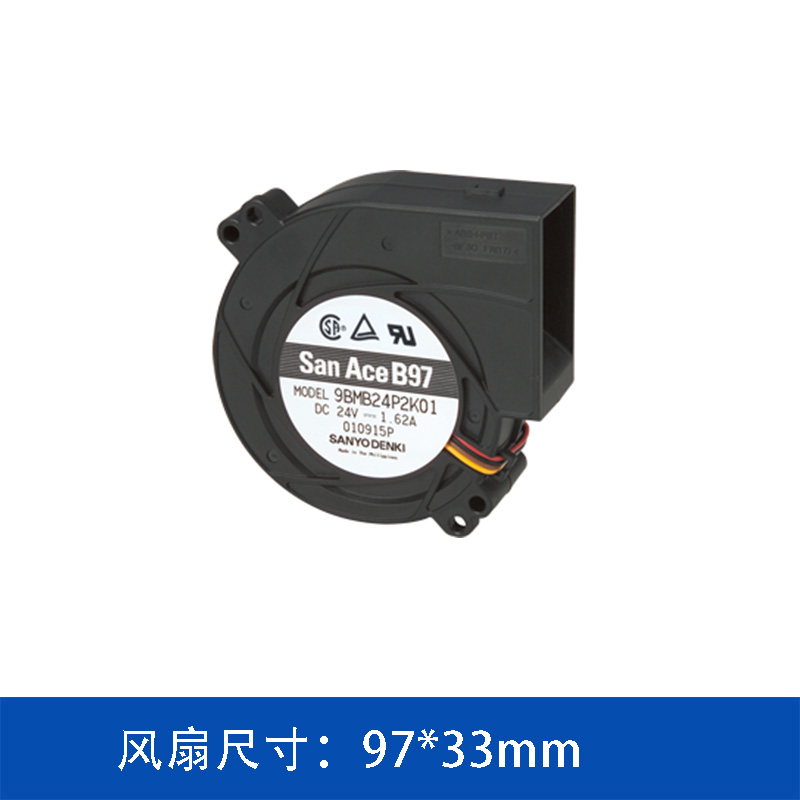
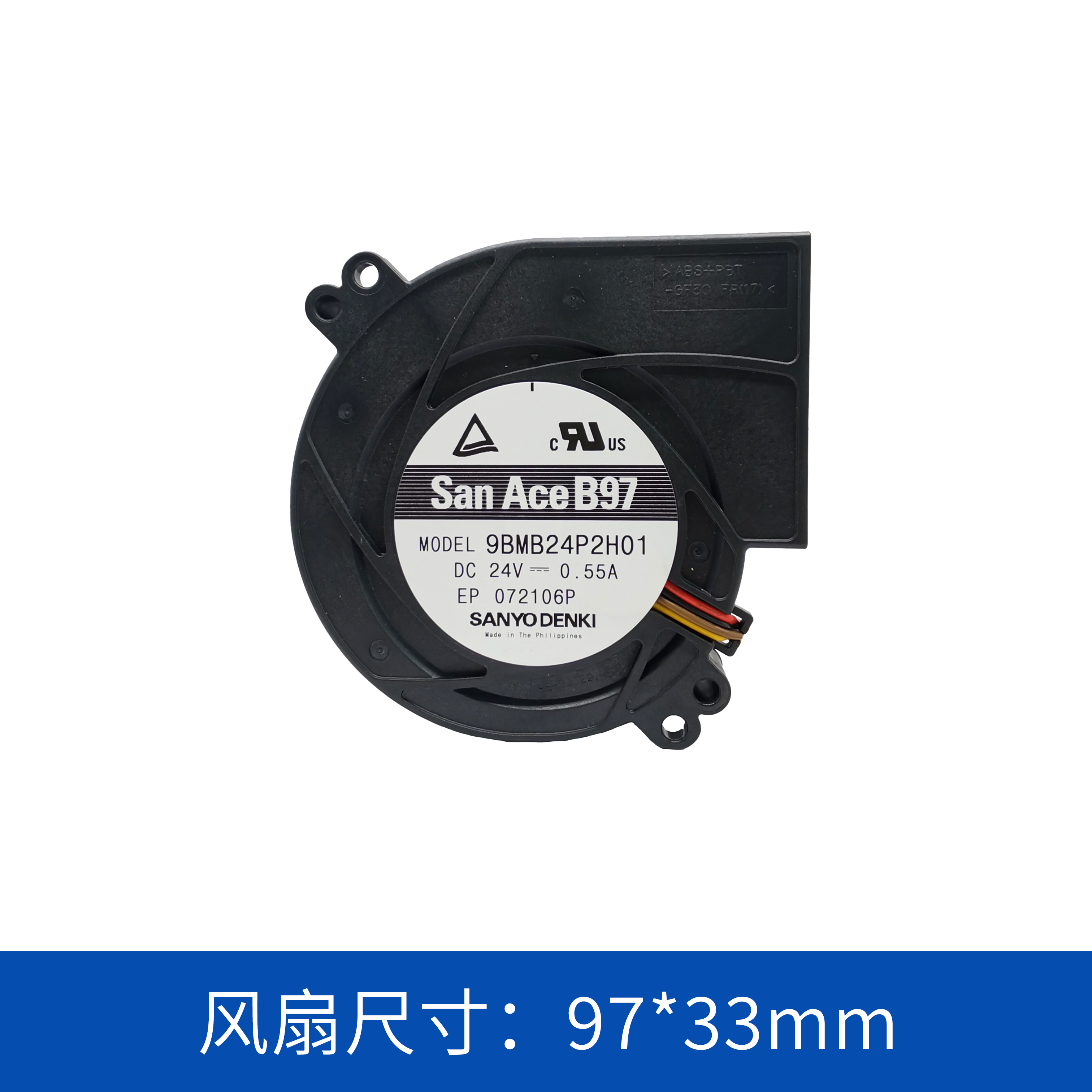
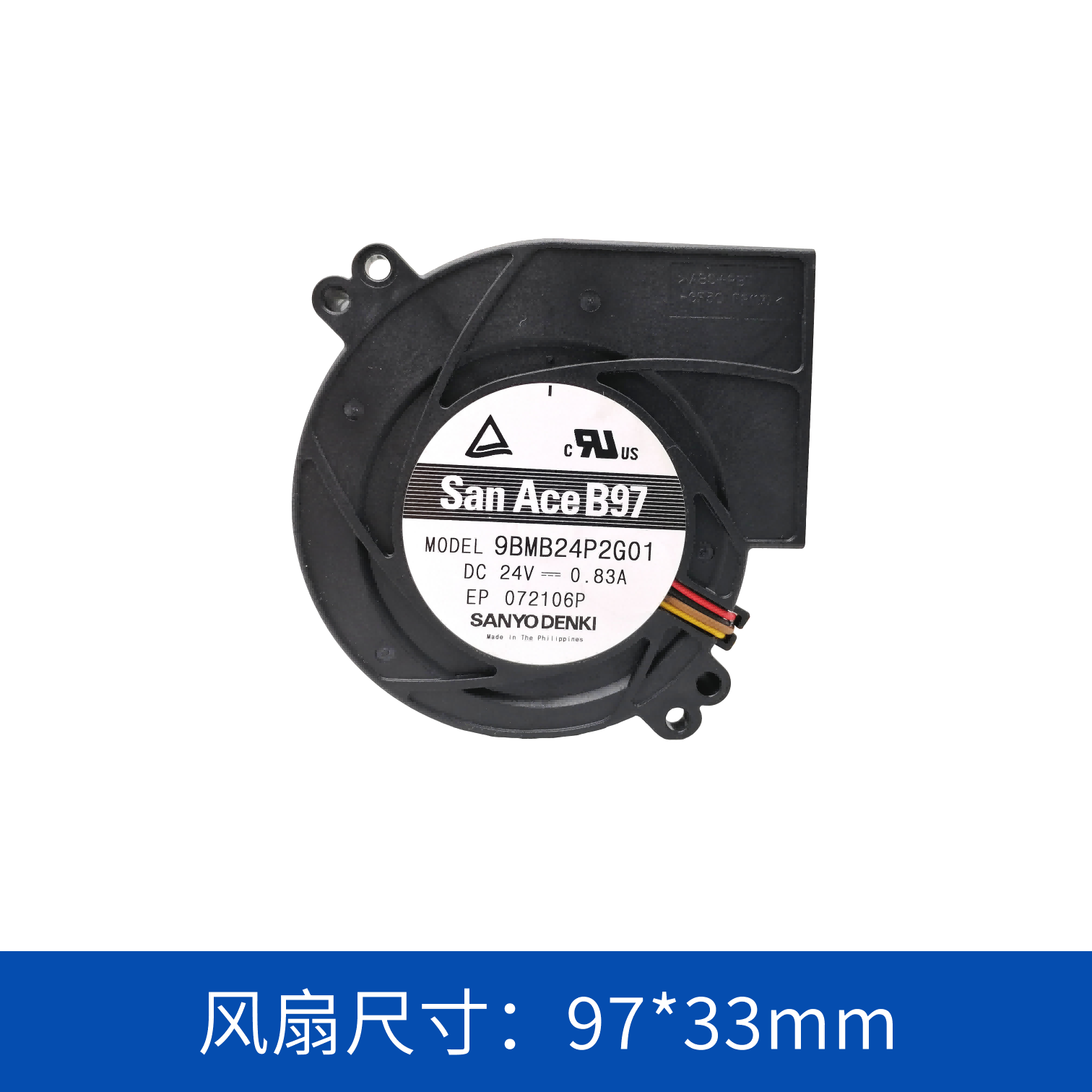
SANYO DENKI San Ace 9BMB24G201 24V 9733 DC Blower Fan
The SANYO DENKI San Ace 9BMB24G201 is a 24V DC blower fan designed for compact electronic equipment where controlled airflow and pressure performance are important considerations.
With a 97 × 97 × 33 mm form factor, the blower provides a maximum airflow of 47.3 CFM and maximum static pressure of 760 Pa. Its compact structure makes it suitable for equipment in which the available cooling space is limited while internal airflow still needs to overcome system resistance.
The model also incorporates a pulse sensor for rotational feedback, allowing the equipment controller to monitor fan operation.
9BMB24G201 Specifications
The key specifications of the San Ace 9BMB24G201 are listed below.
|
Specification
|
9BMB24G201
|
|
Product Type
|
DC Blower
|
|
Brand
|
SANYO DENKI San Ace
|
|
Model
|
9BMB24G201
|
|
Fan Size
|
97 × 97 mm
|
|
Fan Thickness
|
33 mm
|
|
Rated Voltage
|
24 V DC
|
|
Rated Current
|
0.83 A
|
|
Rated Power
|
19.9 W
|
|
Rated Speed
|
5,750 min-1
|
|
Maximum Airflow
|
1.34 m³/min / 47.3 CFM
|
|
Maximum Static Pressure
|
760 Pa / 3.052 inchH₂O
|
|
Noise Level
|
61 dBA
|
|
Sensor
|
Pulse Sensor
|
|
PWM Control
|
No
|
|
Expected Life
|
40,000 h at 60°C / 70,000 h at 40°C
|
These specifications position the 9BMB24G201 as a mid-performance option within the 97 × 33 mm San Ace DC blower range.
Why Use a Blower in Compact Electronic Equipment?
Cooling requirements change significantly as electronic equipment becomes smaller and more densely populated.
A conventional axial fan is generally effective when air can move relatively freely through the equipment. However, the airflow path becomes more complicated when components are packed closely together.
Heatsinks, filters, circuit boards, protective structures and narrow ventilation passages can all increase airflow resistance.
A blower provides a different airflow configuration. Air enters through the intake and is discharged through the outlet in a direction approximately 90 degrees from the intake direction.
This configuration can help equipment designers create a more direct internal airflow path without relying entirely on external duct structures.
Compact 97 × 33 mm Form Factor
The 97 × 97 × 33 mm dimensions are one of the practical advantages of this model.
For compact electronic equipment, available fan space is often determined by the enclosure rather than by the theoretical cooling requirement. Increasing fan size may not be possible because of PCB layout, mounting structures or other internal components.
A 33 mm thick blower provides an alternative configuration for applications where a deeper blower design can be accommodated.
The 9BMB24G201 can therefore be considered during the mechanical design stage of:
-
Communication equipment
-
Industrial control systems
-
Power electronics
-
Storage equipment
-
Server-related equipment
-
Compact electronic assemblies
47.3 CFM Airflow and 760 Pa Static Pressure
The 9BMB24G201 provides a maximum airflow of 47.3 CFM, equivalent to 1.34 m³/min.
Its maximum static pressure is 760 Pa, or approximately 3.052 inchH₂O.
These two values should be considered together rather than separately.
A fan's maximum airflow is generally associated with a low-resistance airflow condition, while maximum static pressure represents the pressure capability under a highly restricted condition.
In an actual equipment installation, the operating point will normally be somewhere between these two extremes.
For this reason, engineers should evaluate the blower against the actual system impedance when selecting a cooling solution.
5,750 min-1 Rated Speed
The rated speed of the 9BMB24G201 is 5,750 min-1.
At this operating condition, the model is specified at:
-
19.9 W rated power
-
0.83 A rated current
-
61 dBA noise
-
47.3 CFM maximum airflow
-
760 Pa maximum static pressure
The relatively compact dimensions combined with this performance make the model suitable for equipment requiring concentrated forced-air cooling.
However, fan selection should always consider the actual thermal load and airflow resistance rather than relying only on rated rotational speed.
Pulse Sensor for Fan Monitoring
The 9BMB24G201 includes a pulse sensor.
A pulse output can provide the equipment controller with information about fan rotation. This is particularly useful in applications where fan operation needs to be monitored continuously.
For example, the control system can use rotational feedback to identify conditions such as:
-
Fan stoppage
-
Abnormal reduction in rotational speed
-
Cooling system faults
-
Maintenance requirements
For equipment designed for continuous operation, this type of feedback can be incorporated into the system's fault monitoring strategy.
Applications for San Ace 9BMB24G201
Communication Equipment
Communication systems often combine high component density with limited enclosure space.
The blower configuration allows airflow to be redirected within the equipment, making it useful when the cooling airflow cannot follow the same axis as the fan intake.
Industrial Control Equipment
Industrial electronic equipment may operate continuously and require stable internal temperatures.
The 24V DC power supply of the 9BMB24G201 is compatible with many industrial control architectures, while the pulse sensor can support equipment-level fan monitoring.
Power Electronics
Power conversion components can generate significant localized heat.
When heatsinks or internal structures create airflow resistance, a blower can be considered as part of the forced-air cooling design.
Storage and Electronic Systems
Storage systems and other compact computing equipment may contain multiple heat-generating components in a restricted enclosure.
The 760 Pa static pressure capability provides additional pressure head for cooling paths containing airflow restrictions.
What Should Engineers Check Before Selecting the 9BMB24G201?
The model should be evaluated according to the complete thermal and mechanical requirements of the target equipment.
Airflow Resistance
Determine whether the cooling path contains:
-
Heatsinks
-
Filters
-
Narrow vents
-
Ducts
-
Dense PCB assemblies
-
Other airflow restrictions
These factors affect the actual operating point of the blower.
Heat Load
The required cooling airflow depends on the heat generated by the equipment.
A higher heat load generally requires greater heat removal capacity, but simply increasing airflow is not always the most effective approach. Airflow distribution and pressure capability also need to be considered.
Installation Space
The available mounting envelope should be checked against the 97 × 97 × 33 mm dimensions.
The intake and discharge areas should also be kept sufficiently clear to prevent unnecessary airflow losses.
Noise
The specified noise level is 61 dBA.
If the final equipment has strict acoustic requirements, the complete system should be evaluated because enclosure structures, ducts and airflow turbulence can affect the final acoustic performance.
San Ace 9BMB24G201 Summary
The SANYO DENKI San Ace 9BMB24G201 is a 24V, 97 × 97 × 33 mm DC blower fan designed for compact electronic cooling applications.
Its key performance characteristics include 47.3 CFM maximum airflow, 760 Pa maximum static pressure, 5,750 min-1 rated speed, and 19.9 W rated power. The model also provides pulse sensor feedback for fan rotation monitoring.
Compared with selecting a cooling fan simply according to its free-air airflow rating, the 9BMB24G201 is better evaluated according to the complete airflow path of the target equipment.
For applications where the enclosure is compact, airflow resistance is present and the cooling direction requires greater layout flexibility, a 97 × 33 mm San Ace blower can provide a practical approach to forced-air thermal management.
Note: The specifications above are based on the model data provided for SANYO DENKI San Ace 9BMB24G201. Actual system performance should be verified against the equipment's thermal load, airflow resistance and installation conditions.
 ∷
∷




 Click to inquire