SANYO DENKI San Ace 9BMC12P2G001: A 12V High Static Pressure Blower for High-Density Equipment Cooling
As electronic equipment continues to become more compact and powerful, thermal management is becoming increasingly challenging. Servers, storage systems, communication equipment, and other high-density electronic devices often generate significant amounts of heat within limited internal spaces.
In these applications, simply selecting a cooling fan with high airflow is not always enough. When the equipment contains narrow air passages, heat sinks, filters, protective structures, or densely arranged components, the cooling system needs a fan capable of maintaining airflow against system resistance.
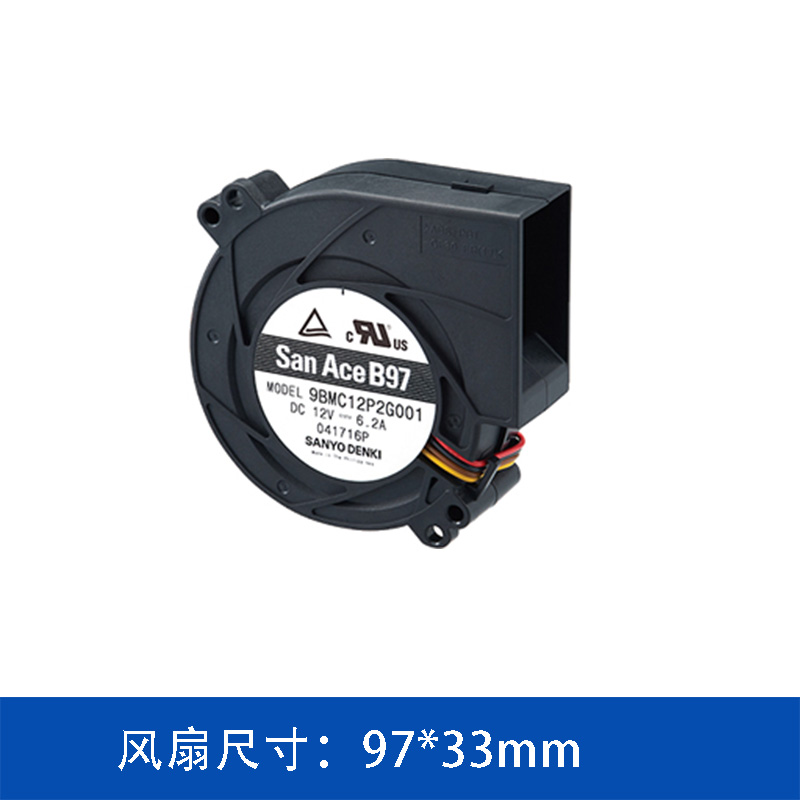
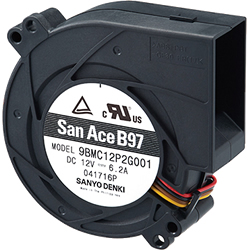
The SANYO DENKI San Ace 9BMC12P2G001 is a 12V DC blower designed for applications where high static pressure and compact installation are important.
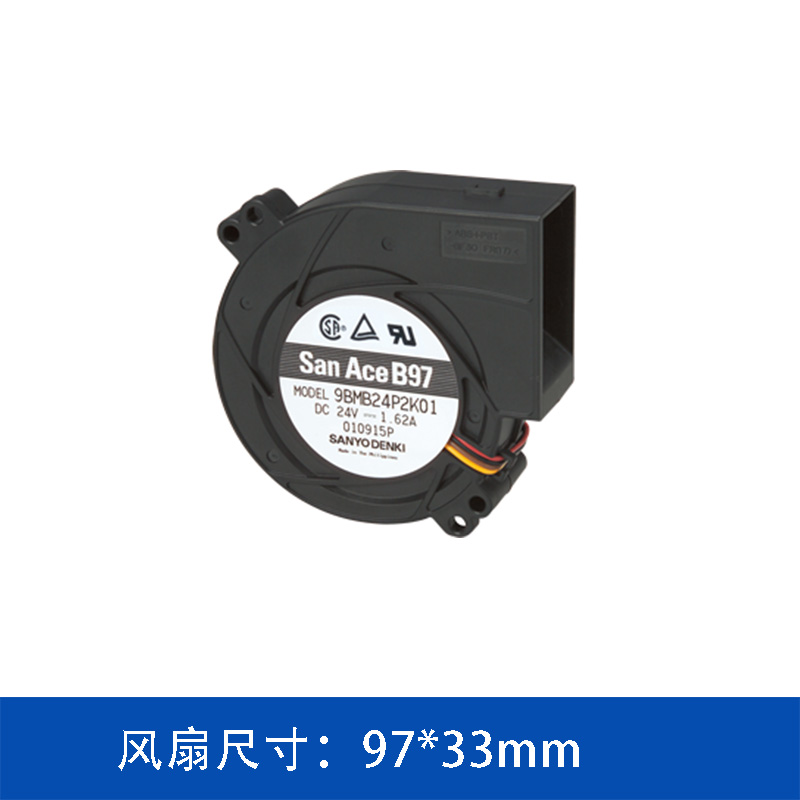
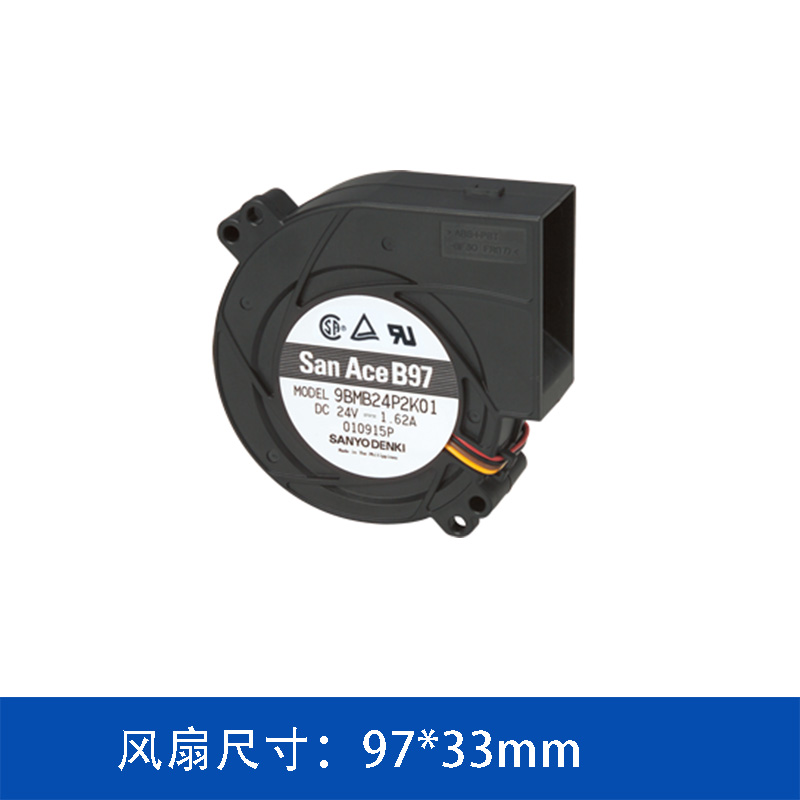
Compact 97×33 mm Blower Design
The 9BMC12P2G001 features a compact 97×33 mm form factor. Compared with conventional axial cooling fans, the blower configuration provides greater flexibility when designing airflow paths inside compact equipment.
A blower takes air in through the intake and discharges it in a direction approximately 90 degrees from the intake direction. This configuration can help equipment designers change the airflow direction without adding a separate external duct.
For compact electronic equipment, this can provide greater freedom when arranging internal components and ventilation paths.
High Static Pressure for High-Resistance Airflow Systems
One of the key specifications of the 9BMC12P2G001 is its maximum static pressure of 1,950 Pa.
Static pressure is particularly important when the airflow path has significant resistance. Examples include:
-
Dense heat sink structures
-
Narrow internal air channels
-
Long or complicated airflow paths
-
Air filters and protective grilles
-
High-density electronic component layouts
-
Compact server and storage enclosures
A fan's maximum airflow specification is normally measured under free-air conditions. In an actual device, however, the operating point is determined by the interaction between the fan performance curve and the system resistance.
Therefore, for equipment with high airflow resistance, evaluating static pressure and the actual operating point can be more meaningful than comparing maximum airflow alone.
74.4 W Rated Power and 8,200 min⁻¹ Speed
The 9BMC12P2G001 is rated for 12 V DC, with a rated current of 6.2 A and rated power of 74.4 W.
Its rated speed reaches 8,200 min⁻¹, enabling the blower to deliver up to:
|
Specification
|
9BMC12P2G001
|
|
Rated Voltage
|
12 V DC
|
|
Rated Current
|
6.2 A
|
|
Rated Power
|
74.4 W
|
|
Rated Speed
|
8,200 min⁻¹
|
|
Maximum Airflow
|
65.3 CFM
|
|
Maximum Static Pressure
|
1,950 Pa
|
|
Noise Level
|
69 dBA
|
|
Sensor
|
Pulse sensor
|
|
PWM Control
|
Yes
|
|
Size
|
97 × 33 mm
|
|
Expected Life
|
40,000 h at 60°C / 70,000 h at 40°C
|
The combination of high rotational speed, high airflow capacity, and high static pressure makes this model suitable for demanding thermal management applications.
Up to 65.3 CFM Airflow
The maximum airflow of the 9BMC12P2G001 reaches 65.3 CFM, equivalent to approximately 1.85 m³/min.
However, the actual airflow inside a device will normally be lower than the maximum free-air airflow because of system impedance.
For engineering selection, it is therefore recommended to consider the complete airflow path rather than using the maximum CFM value as the only selection criterion.
A practical evaluation should consider:
Heat generation → required heat removal → airflow requirement → system impedance → fan operating point
This approach helps determine whether the selected cooling fan can provide sufficient airflow under the actual operating conditions of the equipment.
PWM Control for Dynamic Thermal Management
The 9BMC12P2G001 supports PWM control, allowing fan speed to be adjusted according to the thermal requirements of the equipment.
This can be useful in systems where the heat load varies during operation.
For example, a device may operate at relatively low load during standby or normal operation, while CPU, power electronics, storage devices, or communication modules generate substantially more heat under peak load.
Instead of operating the blower continuously at maximum speed, a PWM-based control strategy can adjust the cooling capacity according to temperature or system load.
A typical thermal management strategy can be structured as:
Low thermal load → lower fan speed → reduced acoustic output and power consumption
High thermal load → higher fan speed → increased airflow and cooling capacity
The actual control strategy should be determined according to the thermal design and control architecture of the equipment.
Pulse Sensor for Fan Status Monitoring
The 9BMC12P2G001 is equipped with a pulse sensor.
A pulse output can provide the equipment controller with information related to fan rotation. This makes it possible to monitor fan operating status and detect abnormal conditions such as fan stoppage or significant changes in rotational speed.
For equipment requiring continuous operation, fan monitoring can be an important part of the overall reliability strategy.
Instead of treating the cooling fan as an independent component, the equipment control system can integrate fan status information into its thermal and fault-management logic.
Designed for High-Density Electronic Equipment
The characteristics of the 9BMC12P2G001 make it particularly relevant to equipment where heat generation and airflow resistance are both significant.
Potential applications include:
Servers
Modern servers can generate considerable heat within relatively compact enclosures. High component density also creates complex internal airflow paths.
A high-static-pressure blower can help move air through these restricted paths and provide cooling for heat-generating components.
Storage Systems
Storage equipment combines multiple heat sources with compact internal layouts. Maintaining stable airflow can be important for long-term system operation.
The 97×33 mm blower format can provide a compact cooling solution where installation space is limited.
Communication and Base Station Equipment
Communication equipment may operate continuously and can be installed in environments where thermal loads vary significantly.
The high static pressure capability, PWM control, and pulse sensing functions can support active thermal management and fan status monitoring.
Industrial Electronic Equipment
Industrial controllers, power electronics, test equipment, and other compact electronic systems may contain heat-generating components positioned behind structures that restrict airflow.
In these situations, blower-type cooling can provide an alternative to conventional axial fan arrangements.
Why Blower Selection Should Consider Static Pressure
When selecting a cooling fan, airflow is often the first parameter engineers look at.
However, the question should not simply be:
How much airflow can the fan produce?
A more useful question is:
How much airflow can the fan deliver at the actual resistance of the equipment?
This distinction is particularly important for high-density electronic equipment.
For example, two cooling fans may have similar maximum airflow ratings, but their actual airflow under a high-resistance operating condition can be significantly different.
The 1,950 Pa maximum static pressure of the 9BMC12P2G001 provides a useful indication of its ability to operate against higher system resistance. Final fan selection should nevertheless be based on the fan performance curve and the actual pressure-flow characteristics of the target equipment.
A Compact Solution for Demanding Thermal Designs
The SANYO DENKI San Ace 9BMC12P2G001 combines a compact 97×33 mm blower structure with 65.3 CFM maximum airflow and 1,950 Pa maximum static pressure.
Its 12 V DC power supply, 8,200 min⁻¹ rated speed, PWM control, and pulse sensor make it suitable for thermal management systems that require both high cooling performance and fan monitoring capabilities.
For engineers designing servers, storage systems, communication equipment, and other high-density electronic devices, the model offers a compact blower configuration for applications where airflow resistance is an important part of the thermal design.
When selecting this type of cooling fan, engineers should evaluate not only maximum airflow, but also static pressure, system impedance, operating point, thermal load, acoustic requirements, control method, and expected service life. A properly matched blower can help create a more stable and effective cooling system without unnecessarily increasing the size of the equipment.
 ∷
∷





 Click to inquire