SANYO DENKI San Ace 9BMB12K201: 12V 97×33 mm High Static Pressure Blower for High-Resistance Cooling Systems
As electronic equipment becomes increasingly compact, thermal management is no longer simply a matter of moving a large volume of air through the enclosure.
In many high-density systems, the airflow path itself becomes a major part of the thermal design.
Heat sinks, filters, protective grilles, narrow ventilation openings, internal ducts, and closely packed electronic components can create considerable airflow resistance. Under these conditions, a cooling fan with high free-air airflow but insufficient pressure capability may not deliver the required airflow after installation.
This is where a high static pressure blower can provide an important advantage.
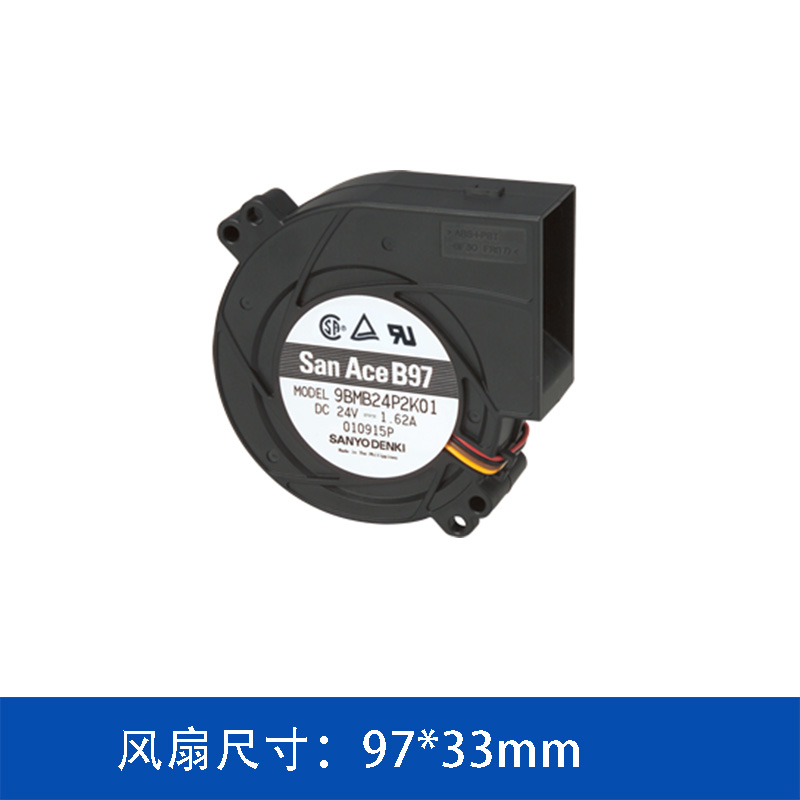
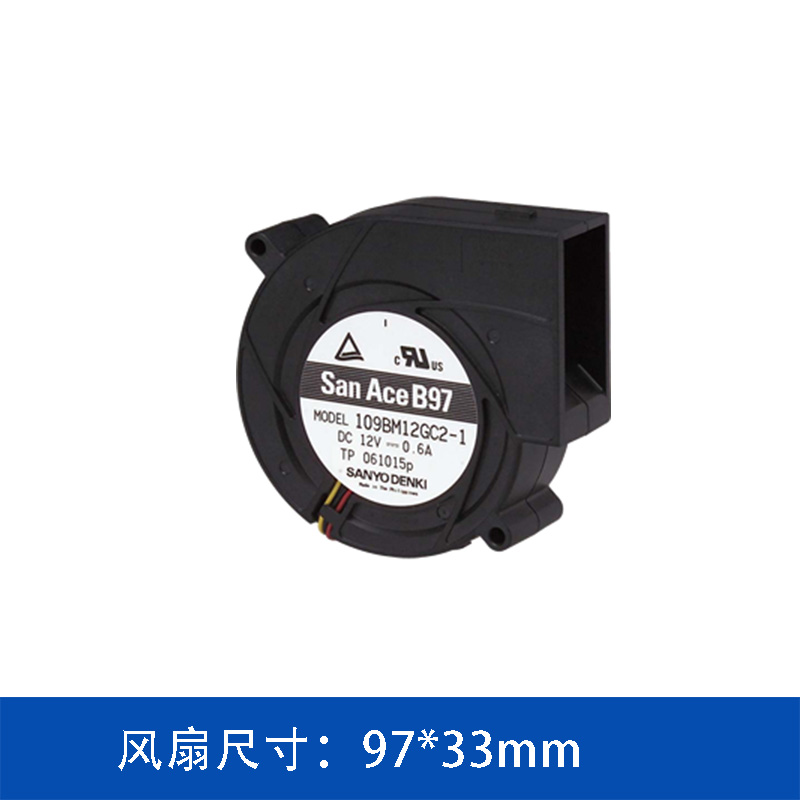
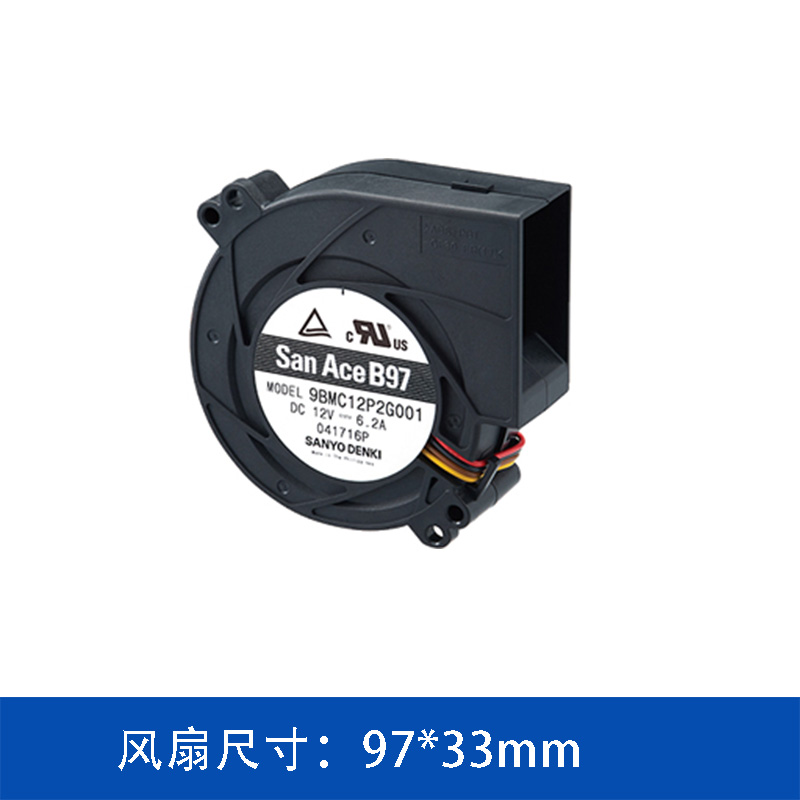
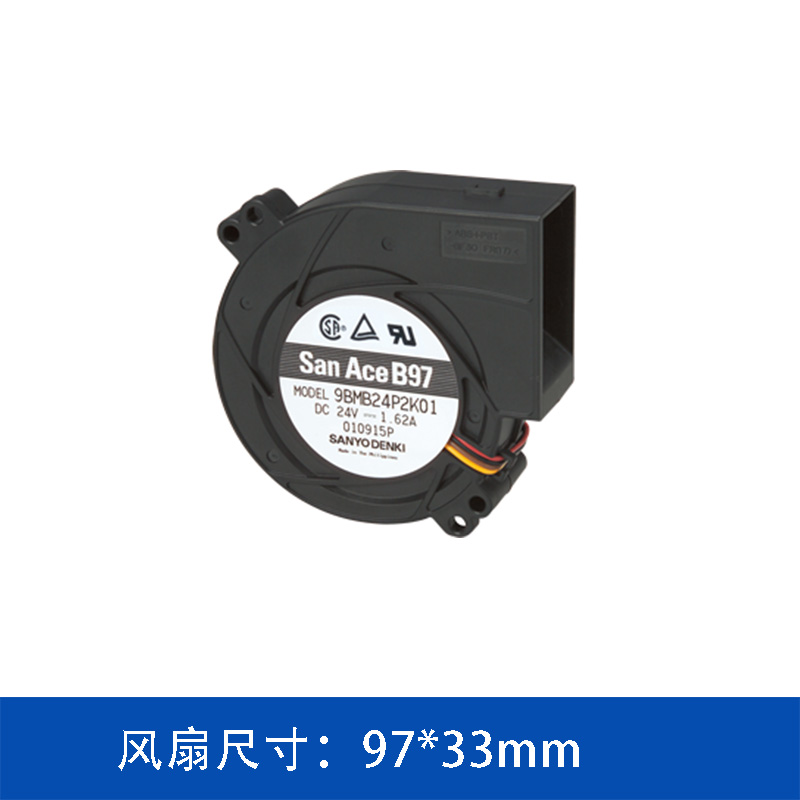
The SANYO DENKI San Ace 9BMB12K201 is a 12V DC blower cooling fan with a compact 97×33 mm form factor. It is designed for applications where both airflow capacity and pressure performance need to be considered.
With a maximum airflow of 56.8 CFM and maximum static pressure of 1,280 Pa, the model provides a high-pressure cooling option within the 9733 blower format.
A 97×33 mm Blower for Space-Constrained Equipment
The 9BMB12K201 measures 97 mm × 33 mm.
This compact form factor is commonly described as a 9733 blower and allows engineers to integrate forced-air cooling into equipment where installation space is limited.
A blower also offers a different airflow arrangement from a conventional axial fan.
Air enters through the intake and is discharged approximately 90 degrees from the intake direction. This makes the blower configuration useful when the cooling airflow needs to be redirected inside a compact enclosure.
Instead of using an axial fan and adding an external structure solely to change the airflow direction, engineers can use the blower's inherent airflow configuration as part of the equipment's mechanical design.
This can simplify airflow routing in certain compact systems.
1,280 Pa Static Pressure for High-Resistance Air Paths
One of the most significant characteristics of the 9BMB12K201 is its 1,280 Pa maximum static pressure, equivalent to approximately 5.14 inchH₂O.
This specification places the model in a high-static-pressure position within the 97×33 mm blower lineup.
Static pressure becomes increasingly important as airflow resistance increases.
Consider an electronic enclosure containing several of the following:
-
High-density heat sinks
-
Fine-pitch protective grilles
-
Air filters
-
Narrow ventilation channels
-
Internal ducts
-
Closely spaced components
-
Long airflow paths
The combined resistance of these elements can significantly affect actual airflow.
A fan's free-air airflow rating does not tell the complete story.
The actual operating point is determined by the interaction between:
Fan performance
and
System resistance
As system impedance rises, a fan needs sufficient pressure capability to continue moving useful airflow through the system.
The 1,280 Pa maximum static pressure of the 9BMB12K201 makes this parameter particularly relevant for high-resistance cooling applications.
56.8 CFM Maximum Airflow
In addition to its pressure capability, the 9BMB12K201 provides a maximum airflow of:
1.61 m³/min
or
56.8 CFM
This combination of airflow and static pressure allows the model to address applications where the cooling system requires both substantial air movement and the ability to overcome airflow resistance.
However, maximum airflow should always be interpreted together with static pressure.
A fan does not normally operate at its maximum airflow once connected to a real cooling system.
The actual airflow depends on the system's resistance.
For this reason, engineers should evaluate the fan's performance curve against the system impedance curve when selecting the final model.
12V DC and 40.8 W Rated Power
The San Ace 9BMB12K201 is a 12V DC blower with a rated current of 3.4 A and rated power of 40.8 W.
Its primary specifications are:
|
Parameter
|
Specification
|
|
Model
|
9BMB12K201
|
|
Product Type
|
Blower
|
|
Size
|
97 × 33 mm
|
|
Rated Voltage
|
12 V DC
|
|
Rated Current
|
3.4 A
|
|
Rated Power
|
40.8 W
|
|
Rated Speed
|
6,850 min⁻¹
|
|
Maximum Airflow
|
1.61 m³/min / 56.8 CFM
|
|
Maximum Static Pressure
|
1,280 Pa / 5.14 inchH₂O
|
|
Noise Level
|
66 dBA
|
|
Sensor
|
Pulse sensor
|
|
PWM Control
|
No
|
|
Expected Life
|
40,000 h at 60°C / 70,000 h at 40°C
|
The 40.8 W rated power reflects the model's higher-speed, high-pressure operating characteristics.
Compared with lower-output 97×33 mm blower models, the 9BMB12K201 is intended for applications where cooling performance and pressure capability take priority over minimizing fan power.
Why High Static Pressure Matters More in Dense Electronic Equipment
In an open environment, a fan with a high airflow rating may appear to be the obvious choice.
Inside an electronic enclosure, however, the situation can be very different.
Imagine a cooling path in which air must pass through a heat sink, a protective grille, and a narrow internal channel before reaching the heat source.
Each element creates resistance.
The airflow delivered by the fan can therefore be substantially lower than its free-air rating.
This is why high static pressure is an important consideration for high-density cooling.
A useful engineering comparison is:
Free-air airflow → tells you how much air the fan can move without system resistance
Static pressure → indicates how effectively the fan can overcome airflow resistance
Operating point → tells you how much airflow the fan can actually deliver in the equipment
The 9BMB12K201's 1,280 Pa maximum static pressure makes it particularly relevant when system impedance is a major design factor.
Pulse Sensor for Fan Monitoring
The 9BMB12K201 includes a pulse sensor for rotational-status feedback.
The signal can be connected to the equipment controller to monitor whether the fan is operating normally.
In applications where thermal management is closely connected to system reliability, fan monitoring can be useful for identifying abnormal operating conditions.
For example, equipment can use fan feedback as part of a monitoring strategy to detect:
-
Fan stoppage
-
Abnormal rotational conditions
-
Cooling system faults
The exact monitoring and protection strategy depends on the design of the target equipment.
Expected Service Life
The specified expected service life of the 9BMB12K201 is:
40,000 hours at 60°C
and
70,000 hours at 40°C
Fan operating temperature is an important factor in long-term thermal management.
A fan installed near a high-power processor, power conversion module, communication module, or other heat-generating component may experience a substantially higher temperature than the ambient environment.
Therefore, service-life evaluation should consider the actual temperature around the fan rather than relying only on room temperature.
Equipment designers should evaluate:
-
Ambient temperature
-
Internal enclosure temperature
-
Heat generation
-
Fan installation location
-
Airflow direction
-
Continuous operating conditions
-
Required service life
This provides a more realistic basis for cooling-system reliability assessment.
Applications of the 9BMB12K201
The high static pressure and compact blower configuration make the 9BMB12K201 particularly relevant to equipment with restricted airflow paths.
High-Density Server Equipment
Server systems can contain processors, power modules, memory, storage devices, and other heat-generating components within a relatively small enclosure.
The resulting airflow path may contain multiple heat sinks and structural restrictions.
The 9BMB12K201 can be evaluated in systems where the cooling design requires a combination of:
High airflow + high static pressure + compact installation
Storage Systems
Storage equipment may also require forced-air cooling through densely arranged drive bays and internal airflow channels.
In such systems, pressure capability can become important because airflow must pass through restricted areas.
The 9BMB12K201's 1,280 Pa maximum static pressure provides a performance characteristic worth considering for these types of applications.
Communication and Networking Equipment
Communication equipment may operate continuously while containing multiple heat-generating components in a compact enclosure.
A 97×33 mm blower provides flexibility in airflow routing, while the high-pressure characteristic can be useful where internal airflow resistance is relatively high.
Industrial Electronic Equipment
Industrial control systems, power electronics, automation equipment, and other industrial devices may require forced-air cooling in compact mechanical structures.
Where ventilation openings, heat sinks, filters, or internal ducts create substantial airflow resistance, a high-static-pressure blower can be considered as part of the thermal solution.
No PWM Control: An Important Selection Consideration
Unlike several other models in the same 97×33 mm blower family, the 9BMB12K201 does not have PWM control according to the supplied specification.
This should be considered during system design.
If the equipment requires dynamic fan-speed adjustment based on temperature or load, engineers need to evaluate whether the selected control architecture is compatible with the fan.
For applications where fixed-speed operation is acceptable, the absence of PWM may not be a limitation.
The key is to match the fan's control characteristics with the requirements of the equipment.
This is also an important reason why cooling fan selection should consider more than airflow and static pressure alone.
Selecting the Right 9733 Blower
The 97×33 mm San Ace blower family includes models with different speed, power, airflow, static pressure, and control characteristics.
The 9BMB12K201 is positioned toward the high-performance, high-static-pressure side of this range.
When comparing 9733 blower models, engineers should consider:
|
Selection Factor
|
Why It Matters
|
|
Airflow
|
Determines the available cooling air volume
|
|
Static pressure
|
Indicates the ability to overcome system resistance
|
|
Power consumption
|
Determines the electrical load of the fan
|
|
Speed
|
Influences airflow, pressure, noise, and power
|
|
Noise
|
Important for acoustic requirements
|
|
Control method
|
Determines how fan operation can be managed
|
|
Sensor
|
Enables rotational-status monitoring
|
|
Operating temperature
|
Affects reliability and service life
|
|
Installation size
|
Determines mechanical compatibility
|
This approach helps avoid selecting a blower simply because it has the highest airflow specification.
Key Specifications of San Ace 9BMB12K201
The main specifications of the SANYO DENKI San Ace 9BMB12K201 are:
-
97×33 mm compact blower
-
12V DC operation
-
3.4 A rated current
-
40.8 W rated power
-
6,850 min⁻¹ rated speed
-
56.8 CFM maximum airflow
-
1,280 Pa maximum static pressure
-
5.14 inchH₂O maximum static pressure
-
66 dBA noise level
-
Pulse sensor
-
No PWM control
-
40,000-hour expected life at 60°C
-
70,000-hour expected life at 40°C
The combination of 56.8 CFM airflow and 1,280 Pa static pressure is the defining characteristic of this model.
Conclusion
The SANYO DENKI San Ace 9BMB12K201 is a 12V 97×33 mm high static pressure blower cooling fan designed for electronic equipment where airflow resistance is an important part of the thermal design.
With 56.8 CFM maximum airflow and 1,280 Pa maximum static pressure, the model provides a high-pressure airflow capability within a compact 9733 form factor.
Its 40.8 W rated power and 6,850 min⁻¹ rated speed reflect its high-performance operating characteristics, while the integrated pulse sensor provides rotational-status feedback for equipment monitoring.
The model is particularly worth evaluating for high-density electronic equipment, servers, storage systems, communication equipment, industrial electronics, and other applications with restrictive airflow paths.
For final selection, engineers should not compare cooling fans solely by maximum airflow. The complete system should be evaluated using heat generation, required airflow, system impedance, fan performance curves, operating point, power consumption, noise requirements, control method, operating temperature, and expected service life.
In applications where airflow resistance is high and available installation space is limited, the 97×33 mm San Ace 9BMB12K201 provides a compact high-static-pressure option for forced-air thermal management.
 ∷
∷




 Click to inquire