San Ace 109BM12GC2-1: 12V 97×33mm DC Blower for Compact and Low-Power Cooling
As electronic equipment becomes increasingly compact, thermal management does not always require the highest possible airflow or static pressure. In many applications, the cooling requirement is more moderate: the equipment needs a compact blower that can provide controlled forced airflow while keeping electrical consumption and acoustic output within an appropriate range.
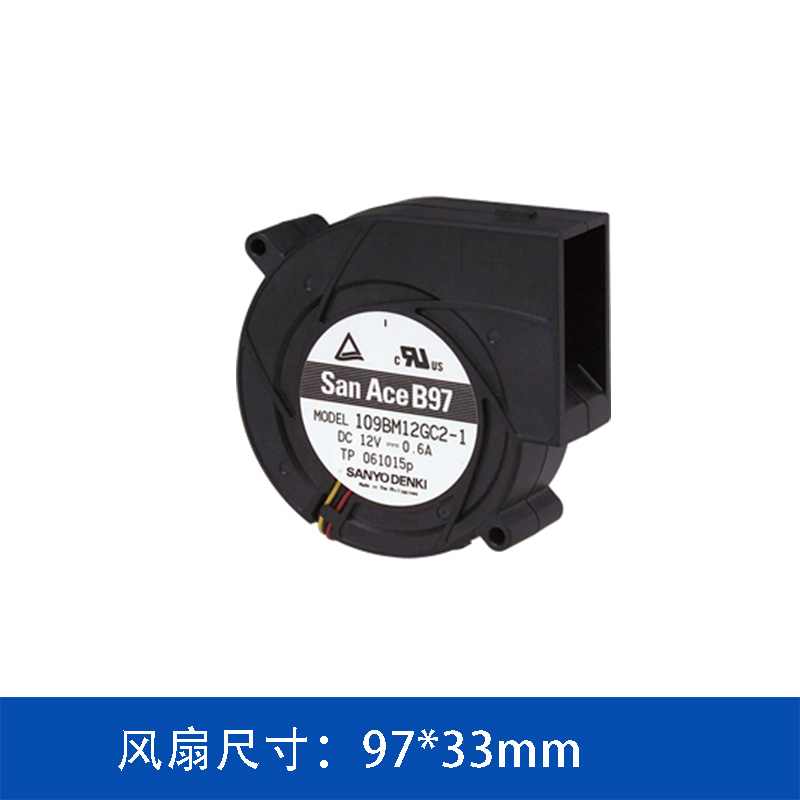
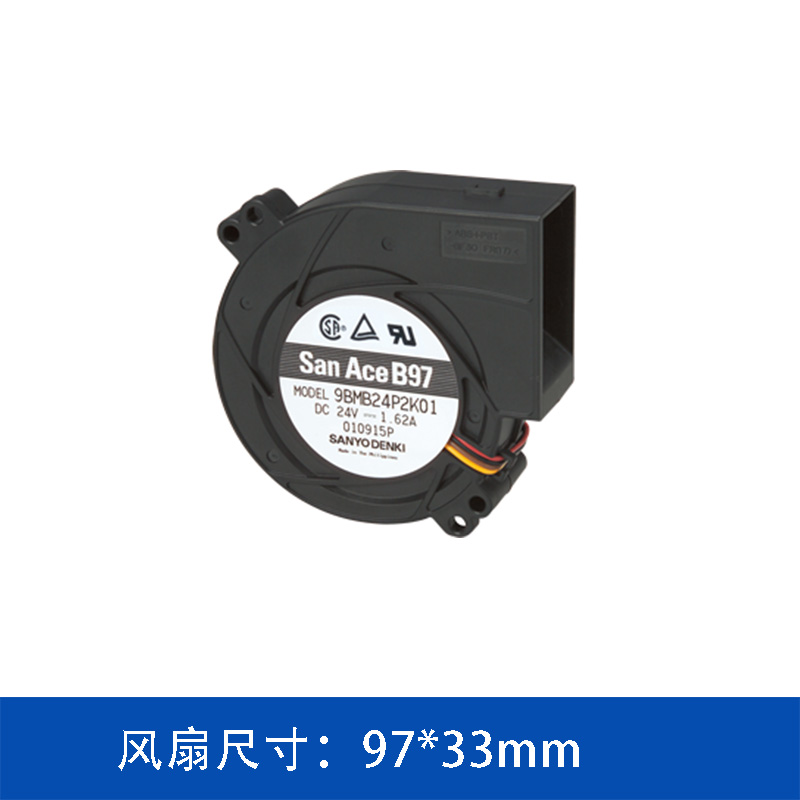
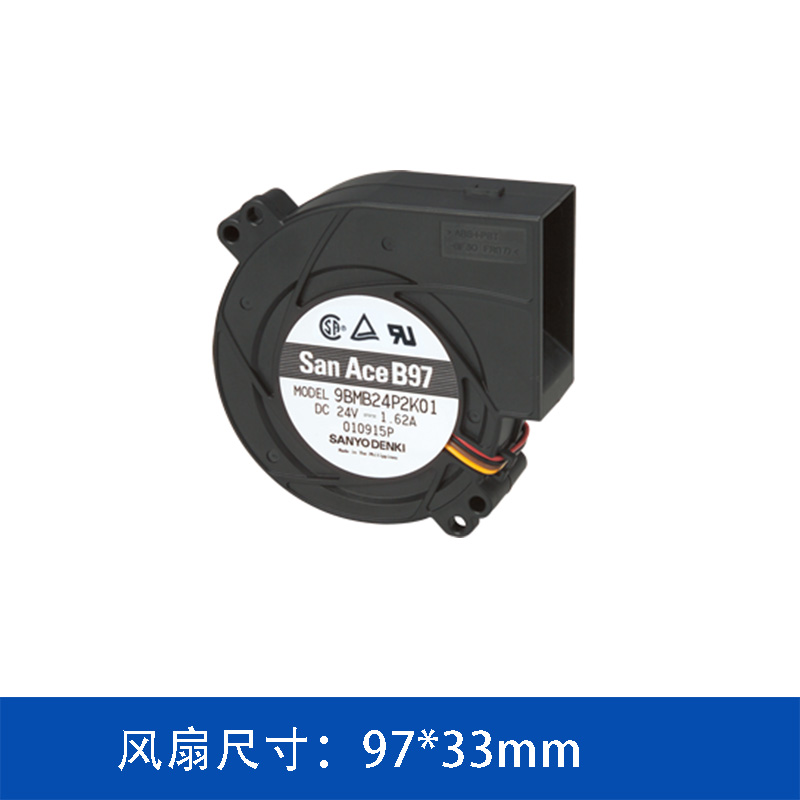
The SANYO DENKI San Ace 109BM12GC2-1 is a 97×97×33mm DC blower designed for this type of application.
Operating at 12 V DC, the model has a rated current of 0.6 A and rated power consumption of 7.2 W. It provides a maximum airflow of 28.9 CFM and maximum static pressure of 281 Pa, with a rated speed of 3,800 min⁻¹.
1. 109BM12GC2-1 Technical Specifications
The 109BM12GC2-1 belongs to the San Ace 97×33mm DC blower lineup. Compared with higher-performance models in the same size class, this model offers a lower rated power and rotational speed.
|
Parameter
|
Specification
|
|
Model
|
109BM12GC2-1
|
|
Product Type
|
DC Blower
|
|
Dimensions
|
97 × 97 × 33 mm
|
|
Rated Voltage
|
12 V DC
|
|
Rated Current
|
0.6 A
|
|
Rated Power
|
7.2 W
|
|
Rated Speed
|
3,800 min⁻¹
|
|
Maximum Airflow
|
0.82 m³/min
|
|
Maximum Airflow
|
28.9 CFM
|
|
Maximum Static Pressure
|
281 Pa
|
|
Maximum Static Pressure
|
1.129 inchH3O
|
|
Noise Level
|
51.5 dBA
|
|
Sensor
|
Pulse Sensor
|
|
Expected Life
|
40,000 h at 60°C / 70,000 h at 40°C
|
|
PWM Control
|
No
|
These specifications position the 109BM12GC2-1 as a compact blower option for applications where moderate airflow and pressure are sufficient for the thermal requirements.
2. A Compact Blower for Moderate Cooling Requirements
Not every electronic system requires a high-output cooling fan.
For example, equipment may contain processors, communication modules, power supplies or control electronics that generate heat continuously but do not require the cooling capacity of high-speed blowers.
In such applications, selecting an unnecessarily powerful fan can increase:
-
Power consumption
-
Acoustic output
-
Airflow turbulence
-
Mechanical requirements
-
Overall cooling-system cost
A more appropriate approach is to match the blower to the actual thermal load and system resistance.
The 109BM12GC2-1 provides 28.9 CFM maximum airflow and 281 Pa maximum static pressure, making it a model worth considering when the required operating point falls within this performance range.
3. Understanding the 281 Pa Static Pressure Rating
The maximum static pressure of the 109BM12GC2-1 is 281 Pa.
Static pressure represents the blower's ability to overcome resistance within an airflow system.
Actual equipment may contain several sources of resistance, including:
-
Heat sinks
-
Ventilation openings
-
Filters
-
Protective grilles
-
Internal partitions
-
Narrow airflow channels
-
Cable bundles
-
Dense electronic assemblies
The more restricted the airflow path becomes, the more important static pressure becomes during fan selection.
For this reason, the 109BM12GC2-1 should not be selected simply by looking at its 28.9 CFM maximum airflow.
The more meaningful evaluation is the blower's performance curve under the actual system resistance.
4. 28.9 CFM Airflow for Compact Electronic Systems
The 109BM12GC2-1 has a maximum airflow of:
0.82 m³/min
or:
28.9 CFM.
This level of airflow can be useful for compact electronic equipment where the thermal load is moderate and the system does not require the airflow capacity of a higher-speed blower.
Potential equipment categories include:
-
Communication equipment
-
Industrial controllers
-
Network devices
-
Electronic control systems
-
Compact power supplies
-
Automation equipment
-
Instrumentation
-
Storage and computing equipment
The final airflow requirement should always be calculated from the equipment's heat generation and allowable temperature rise.
5. Why the 97×33mm Size Matters
The physical dimensions of a cooling fan can become a major constraint when the enclosure is already designed around a specific PCB and mechanical structure.
The 97×97×33mm format offers a relatively compact blower package while providing a dedicated airflow outlet.
The 33mm thickness can be useful in equipment where the available installation depth is restricted.
Before selecting the blower, engineers should confirm:
-
Mounting-hole dimensions
-
Installation clearance
-
Air inlet space
-
Air outlet space
-
Airflow direction
-
Cable routing
-
Clearance from surrounding components
A blower should have sufficient free space around both the inlet and outlet to avoid unnecessarily increasing system resistance.
6. 12V DC and 7.2W Rated Power
The 109BM12GC2-1 operates at 12 V DC and has a rated current of 0.6 A.
Its rated power consumption is:
7.2 W
This is an important characteristic for systems where the cooling fan operates continuously.
In a device containing multiple fans, the difference in power consumption between fan models can accumulate significantly over long operating periods.
Therefore, when the thermal design allows the use of a lower-power blower, selecting a properly matched model can help avoid unnecessary electrical consumption.
However, lower power should not be treated as an independent selection target. The blower must still provide adequate airflow at the actual system operating point.
7. 3,800 min⁻¹ Rated Speed
The rated speed of the 109BM12GC2-1 is 3,800 min⁻¹.
Compared with higher-speed blower configurations, a lower rated rotational speed can be appropriate for applications where the required cooling performance is moderate.
Fan speed is related to several system characteristics, including:
-
Airflow
-
Static pressure
-
Noise
-
Power consumption
-
Thermal performance
Therefore, rotational speed should be evaluated as part of the complete fan performance rather than used as a standalone indicator of cooling capability.
8. 51.5 dBA Noise Level
The specified noise level of the 109BM12GC2-1 is 51.5 dBA.
In actual equipment, the final acoustic performance can differ from the datasheet value because the surrounding enclosure changes the airflow and sound characteristics.
Particular attention should be paid to:
-
Air inlet geometry
-
Outlet geometry
-
Ventilation grilles
-
Heat sinks
-
Ducts
-
Enclosure panels
-
Installation resonance
For products installed in office, laboratory, communication or other noise-sensitive environments, system-level acoustic testing is recommended after installation.
9. Pulse Sensor for Fan Monitoring
The 109BM12GC2-1 includes a Pulse Sensor.
The pulse output can be used by the host equipment to monitor fan rotation.
This can be useful in applications where a cooling-fan failure could affect system reliability.
Depending on the control architecture, the equipment can use the signal for functions such as:
-
Rotation monitoring
-
Fan failure detection
-
Abnormal-speed identification
-
Maintenance notification
-
System alarm management
This feature allows the cooling fan to become part of the equipment's broader reliability monitoring strategy.
10. Expected Service Life
The expected service life of the 109BM12GC2-1 is specified as:
40,000 hours at 60°C
and:
70,000 hours at 40°C.
Operating temperature is an important factor when evaluating long-term fan reliability.
The temperature around the fan may be higher than the ambient temperature outside the equipment because internal electronic components generate heat.
Therefore, engineers should evaluate the actual operating environment of the blower rather than using room temperature alone when estimating service life.
11. Where Can the 109BM12GC2-1 Be Used?
The performance profile of the 109BM12GC2-1 makes it suitable for applications requiring a compact forced-air cooling solution without the performance level of a high-output blower.
Communication and Network Equipment
Compact communication devices may require continuous cooling while operating within a limited enclosure.
The blower configuration can provide a controlled airflow path through the system.
Industrial Control Equipment
Industrial controllers can contain processors, power supplies and other heat-producing components.
Where the thermal load is moderate, a 7.2W blower may provide an appropriate balance between cooling capacity and electrical consumption.
Electronic Instrumentation
Measurement and control equipment may have limited internal space and moderate heat generation.
A compact 97×33mm blower can be considered when natural convection does not provide sufficient cooling.
Automation Equipment
Industrial automation systems often require reliable continuous operation.
Forced-air cooling can help remove heat from electronic modules and power components where enclosure space is restricted.
12. How to Evaluate the 109BM12GC2-1 for a Cooling Design
A practical fan-selection process should begin with the equipment rather than the fan.
1. Identify the Heat Sources
Determine which components generate the most heat and estimate their total thermal load.
2. Establish the Temperature Limit
Define the maximum allowable temperature for critical components.
3. Calculate Required Airflow
Estimate how much airflow is required to remove the generated heat.
4. Determine System Impedance
Calculate or test the pressure losses created by heat sinks, filters, grilles and airflow channels.
5. Check the Fan Operating Point
Compare the system resistance curve with the blower performance curve.
6. Confirm Installation Conditions
Check the 97×33mm mechanical dimensions, airflow direction, electrical interface and available inlet/outlet clearance.
7. Consider Reliability
Finally, verify operating temperature, expected service life and fan monitoring requirements.
This approach helps prevent both under-sizing and unnecessary over-sizing of the cooling fan.
13. 109BM12GC2-1 Compared with Higher-Output 97×33mm Blowers
The San Ace 97×33mm lineup contains models with substantially different performance levels.
The 109BM12GC2-1 provides:
-
28.9 CFM maximum airflow
-
281 Pa maximum static pressure
-
7.2 W rated power
-
3,800 min⁻¹ rated speed
-
51.5 dBA noise level
A higher-output model may provide substantially more airflow and pressure, but it may also require greater electrical power and generate higher acoustic output.
Therefore, the highest-performance model is not necessarily the most appropriate choice.
The better approach is to determine the required system operating point first and then select the smallest blower that provides sufficient thermal margin.
14. San Ace 109BM12GC2-1 at a Glance
The SANYO DENKI San Ace 109BM12GC2-1 is a compact 12V DC blower measuring 97×97×33mm.
Its primary specifications are:
-
12 V DC
-
0.6 A rated current
-
7.2 W rated power
-
3,800 min⁻¹ rated speed
-
28.9 CFM maximum airflow
-
281 Pa maximum static pressure
-
51.5 dBA noise level
-
Pulse Sensor
-
40,000 hours at 60°C expected life
-
70,000 hours at 40°C expected life
The model is best evaluated for applications where moderate forced-air cooling is required within a compact installation envelope.
15. Conclusion
The thermal requirements of compact electronic equipment vary considerably from one application to another. Some systems need very high airflow and pressure, while others require a more moderate cooling solution that consumes less power and occupies limited space.
The San Ace 109BM12GC2-1 provides a 97×33mm compact form factor, 12V DC operation, 28.9 CFM maximum airflow and 281 Pa maximum static pressure, together with a rated power consumption of 7.2W.
Its Pulse Sensor also allows fan rotation to be monitored by the host equipment.
For applications with moderate heat generation and relatively controlled airflow resistance, the 109BM12GC2-1 can be evaluated as part of the thermal management system. The final selection should be based on the actual heat load, system impedance, required airflow, operating temperature, acoustic requirements and installation conditions, rather than on maximum airflow alone.
 ∷
∷





 Click to inquire