SANYO DENKI San Ace 9BMB12P2K01: 12V High Static Pressure Cooling Fan for Compact Electronic Equipment
As electronic equipment becomes smaller while heat generation continues to increase, cooling system design must provide sufficient airflow within increasingly restricted spaces. Servers, storage systems, communication equipment, and industrial electronics may contain densely arranged components, narrow ventilation paths, and heat sinks that create significant airflow resistance.
In these conditions, maximum airflow alone does not fully describe a cooling fan's performance. The ability to maintain airflow against system impedance is equally important.
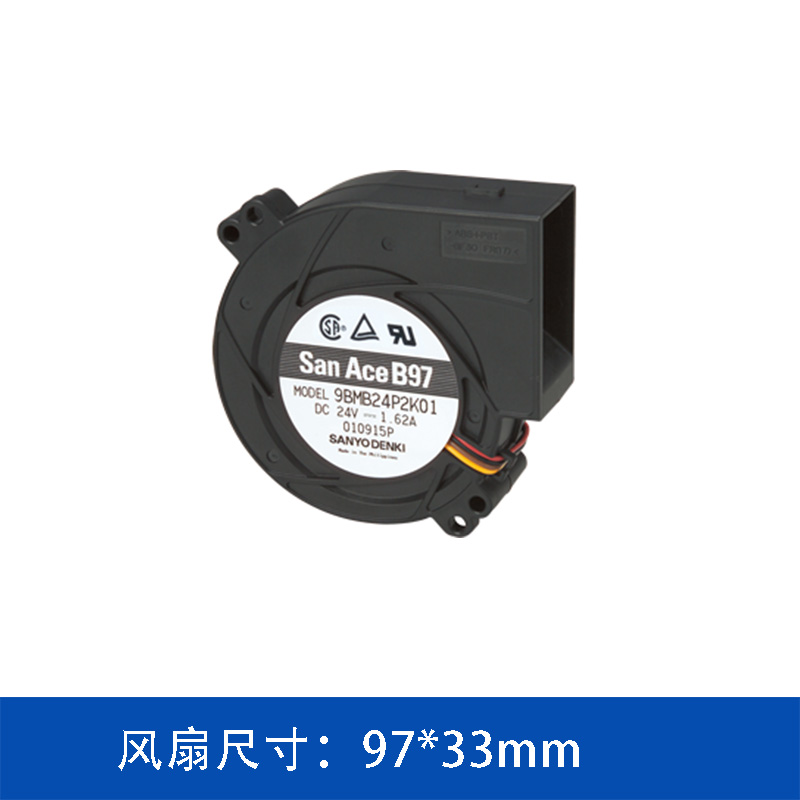
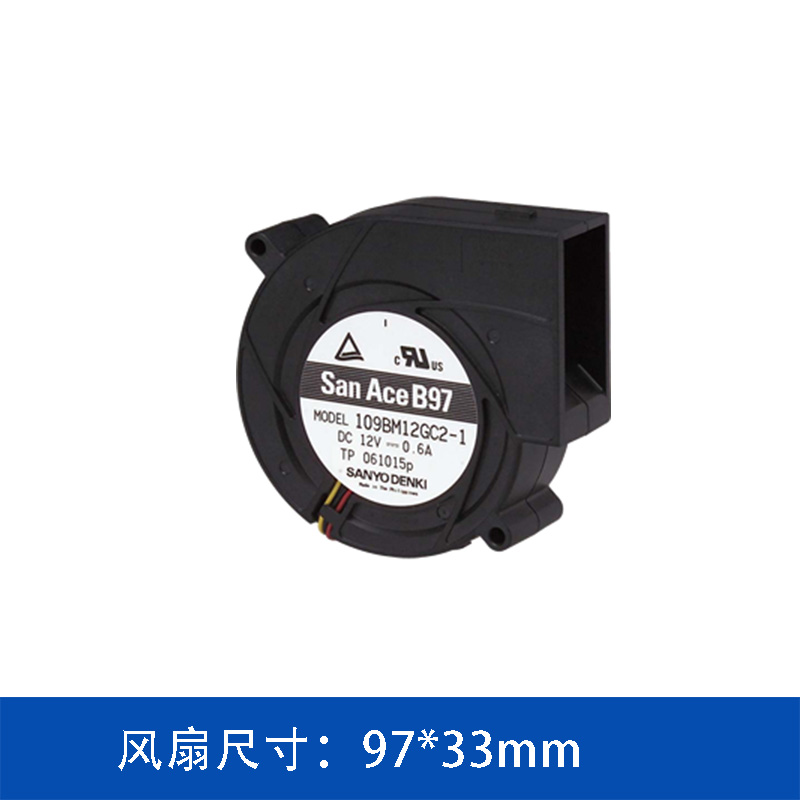
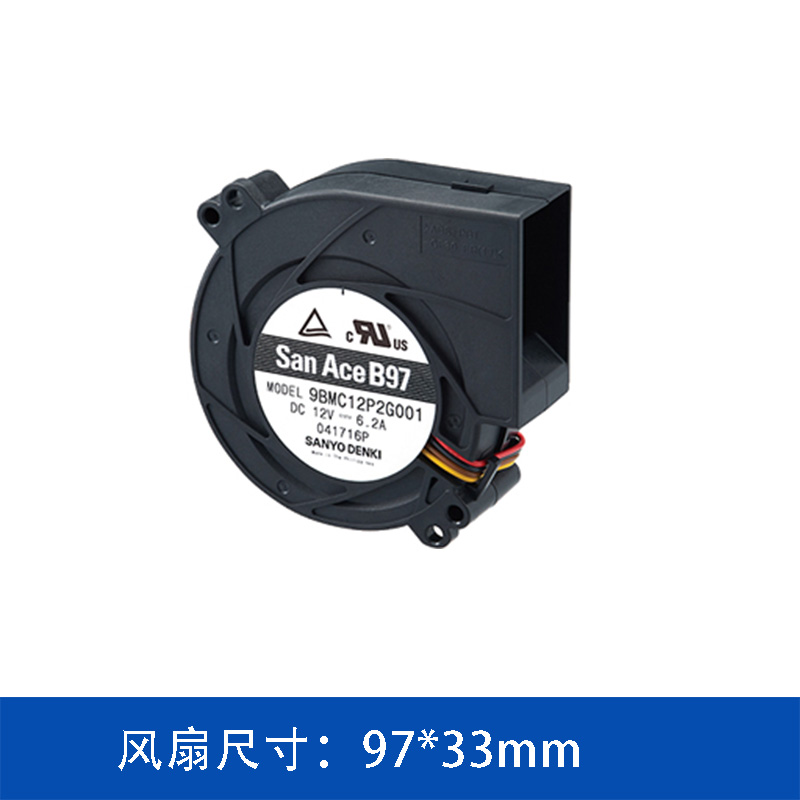
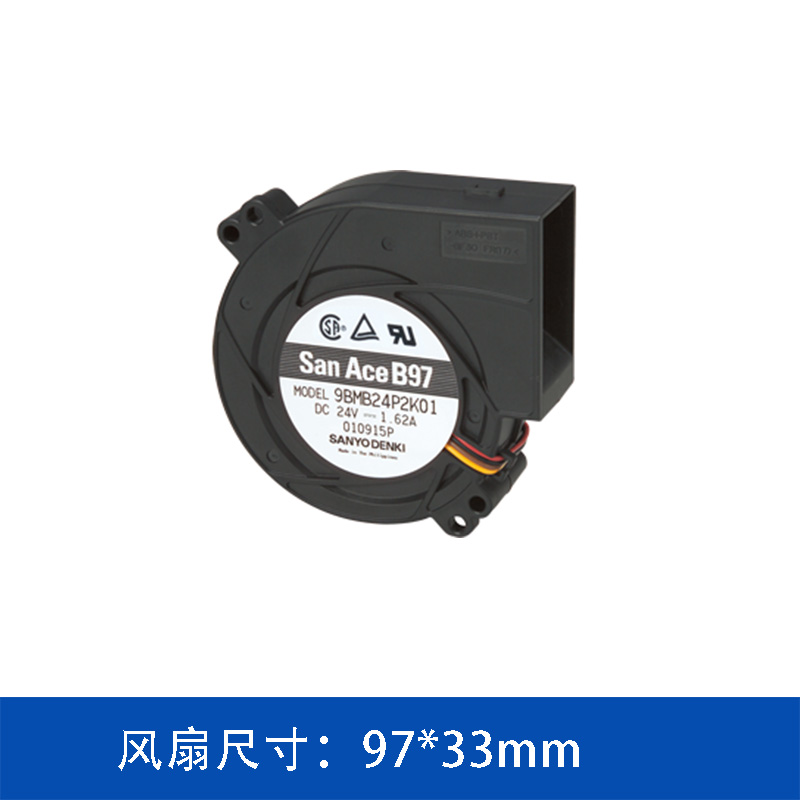
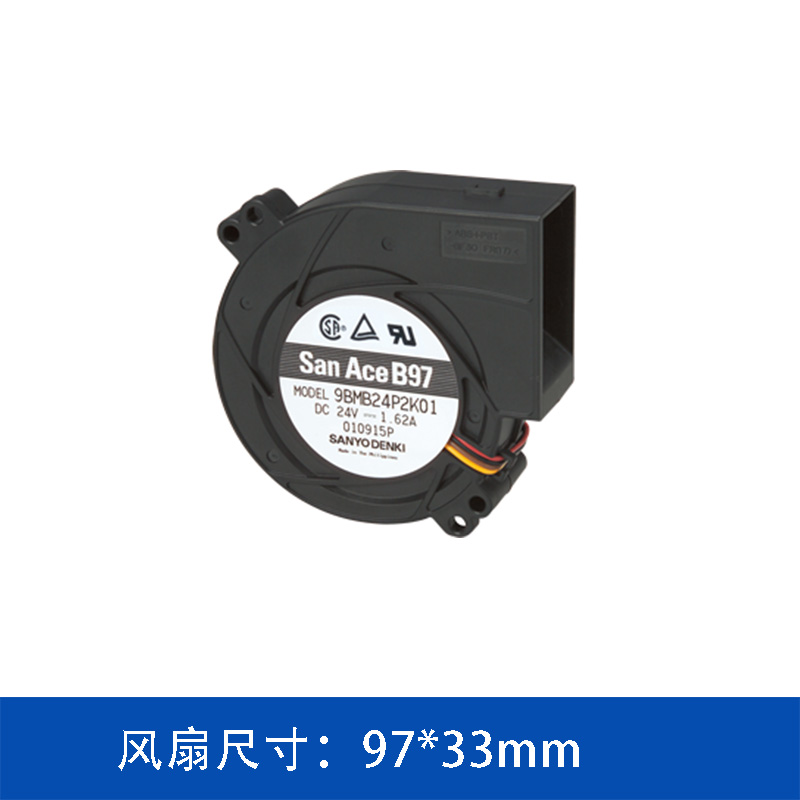
The SANYO DENKI San Ace 9BMB12P2K01 is a 12V DC cooling fan with a compact 97×33 mm blower configuration, designed for applications that require a combination of high static pressure, substantial airflow, compact installation, and controllable operation.
Compact 97×33 mm Blower Design
The 9BMB12P2K01 uses a compact 97×33 mm blower structure.
Unlike a conventional axial fan, a blower can change the airflow direction within the fan assembly. Air enters through the intake and is discharged approximately 90 degrees from the intake direction.
This configuration can help equipment designers create more flexible airflow paths without relying on an additional external duct to change the direction of airflow.
For compact equipment, this can simplify internal thermal design while making better use of limited installation space.
1,280 Pa Maximum Static Pressure
The 9BMB12P2K01 provides a maximum static pressure of 1,280 Pa.
This specification is particularly relevant when the cooling system has considerable airflow resistance.
In actual equipment, airflow may need to pass through heat sinks, filters, protective grilles, narrow channels, or densely arranged electronic components. Each of these elements can increase system impedance.
A fan that provides high airflow in free-air conditions may not necessarily deliver sufficient airflow after installation.
For this reason, engineers should evaluate the relationship between:
Fan performance curve + system resistance curve = actual operating point
The 1,280 Pa maximum static pressure provides the 9BMB12P2K01 with the capability to address applications where airflow resistance is an important part of the thermal design.
56.8 CFM Maximum Airflow
The maximum airflow of the 9BMB12P2K01 reaches 56.8 CFM, equivalent to approximately 1.61 m³/min.
This provides a substantial airflow capacity for compact electronic equipment.
However, maximum airflow is normally specified under free-air conditions. Once the blower is installed into an enclosure, the actual airflow will depend on the resistance of the complete airflow system.
For engineering selection, the required airflow should therefore be evaluated together with system impedance rather than treating CFM as an isolated specification.
A practical cooling design process can be summarized as:
Heat load → required heat dissipation → airflow requirement → system impedance → fan operating point
This approach can help engineers select a cooling fan that performs effectively under actual operating conditions.
40.8 W Rated Power and 6,850 min⁻¹ Speed
The San Ace 9BMB12P2K01 is designed for 12V DC operation.
Its rated electrical and performance specifications include:
|
Parameter
|
Specification
|
|
Rated Voltage
|
12 V DC
|
|
Rated Current
|
3.4 A
|
|
Rated Power
|
40.8 W
|
|
Rated Speed
|
6,850 min⁻¹
|
|
Maximum Airflow
|
56.8 CFM
|
|
Maximum Static Pressure
|
1,280 Pa
|
|
Noise Level
|
66 dBA
|
|
Size
|
97 × 33 mm
|
|
Sensor
|
Pulse sensor
|
|
PWM Control
|
Yes
|
|
Expected Life
|
40,000 h at 60°C / 70,000 h at 40°C
|
Compared with higher-output blower models in the same size class, the 9BMB12P2K01 provides a lower rated power and rotational speed while maintaining substantial airflow and static pressure.
This makes it a useful option when the thermal requirements do not require the highest-performance 97×33 mm blower configuration.
PWM Control for Variable Cooling Requirements
The 9BMB12P2K01 supports PWM control, allowing the fan speed to be adjusted according to the thermal requirements of the equipment.
This can be useful for electronic systems with variable workloads.
For example, a server or communication system may operate at a relatively low thermal load during normal conditions and generate considerably more heat during peak operation.
PWM control can allow the cooling system to adjust fan speed accordingly:
Lower heat generation → lower fan speed
Higher heat generation → higher fan speed
Such control can help balance thermal performance, acoustic requirements, and fan power consumption.
The actual PWM control strategy should be determined according to the equipment's thermal characteristics and control architecture.
Pulse Sensor for Fan Status Monitoring
The 9BMB12P2K01 is equipped with a pulse sensor.
This allows the equipment controller to receive rotational information from the cooling fan and monitor its operating condition.
For systems where cooling fan failure could result in thermal problems, fan status monitoring can be incorporated into the equipment's protection and maintenance strategy.
A controller can use the pulse signal to identify abnormal operating conditions such as fan stoppage or unexpected changes in fan speed.
This is particularly useful for equipment designed for continuous operation.
Expected Service Life
The expected service life of the 9BMB12P2K01 is specified as:
-
40,000 hours at 60°C
-
70,000 hours at 40°C
Operating temperature is an important factor when evaluating cooling fan service life.
The actual environment around the fan depends on equipment enclosure design, heat-generating components, airflow arrangement, installation position, and ambient conditions.
Therefore, when designing a long-life cooling system, engineers should evaluate the expected fan operating temperature rather than relying solely on a nominal service-life figure.
Applications
The 9BMB12P2K01 can be considered for a range of electronic equipment requiring compact, high-static-pressure airflow.
Server Equipment
Servers often combine high heat generation with dense internal layouts. Heat sinks and restricted airflow channels can create substantial system impedance.
The 9BMB12P2K01 provides a combination of 56.8 CFM airflow and 1,280 Pa maximum static pressure for these types of cooling environments.
Storage Systems
Storage equipment may require continuous airflow to maintain stable operating temperatures across drives, controllers, processors, and power components.
The compact 97×33 mm blower configuration can provide greater flexibility for installations where space is limited.
Communication and Base Station Equipment
Communication systems can operate continuously and may experience varying thermal loads.
PWM control provides a way to adjust cooling capacity according to operating conditions, while the pulse sensor allows fan operation to be monitored by the equipment controller.
Industrial Electronic Equipment
Industrial control systems, test equipment, power electronics, and other compact electronic devices may have airflow paths with considerable resistance.
The blower configuration can help direct airflow through restricted internal spaces while maintaining a compact installation footprint.
High Static Pressure Versus Maximum Airflow
When selecting a cooling fan, it is common to compare maximum airflow figures.
However, maximum airflow is only one part of the performance picture.
Consider an electronic enclosure with a restrictive heat sink and narrow ventilation path. The system resistance can significantly reduce the airflow delivered by the fan.
In such an application, a fan with stronger static pressure capability may deliver more useful airflow at the actual operating point.
The 1,280 Pa maximum static pressure of the 9BMB12P2K01 makes it suitable for applications where system impedance cannot be ignored.
Final selection should still be based on the fan performance curve, required airflow, and actual system resistance of the equipment.
Conclusion
The SANYO DENKI San Ace 9BMB12P2K01 is a 12V DC, 97×33 mm high static pressure cooling fan designed in a compact blower configuration.
It provides up to 56.8 CFM airflow and 1,280 Pa static pressure, with a rated speed of 6,850 min⁻¹ and rated power of 40.8 W.
With PWM control, a pulse sensor, and an expected service life of 40,000 hours at 60°C or 70,000 hours at 40°C, the model is suitable for demanding thermal management applications where compact installation and controllable high-pressure airflow are required.
For servers, storage systems, communication equipment, and industrial electronic systems, the 9BMB12P2K01 provides a practical blower solution for managing heat in environments where system airflow resistance is an important design consideration.
 ∷
∷




 Click to inquire